How big is a narwhal?
See all narwhal pictures & images →
Narwhals are medium-sized toothed whales found in the Arctic, occupying a distinct ecological niche between smaller dolphins and the largest cetaceans. Adult males typically measure approximately 4.5 meters (about 15 feet) in length and can weigh up to around 1,600 kilograms. Females are notably smaller, usually reaching about 4 meters and weighing roughly 1,000 kilograms. Newborn calves enter the water at a much smaller scale, measuring between 1.5 and 1.6 meters. These proportions establish narwhals as moderately sized marine mammals adapted to their specialized Arctic habitat.
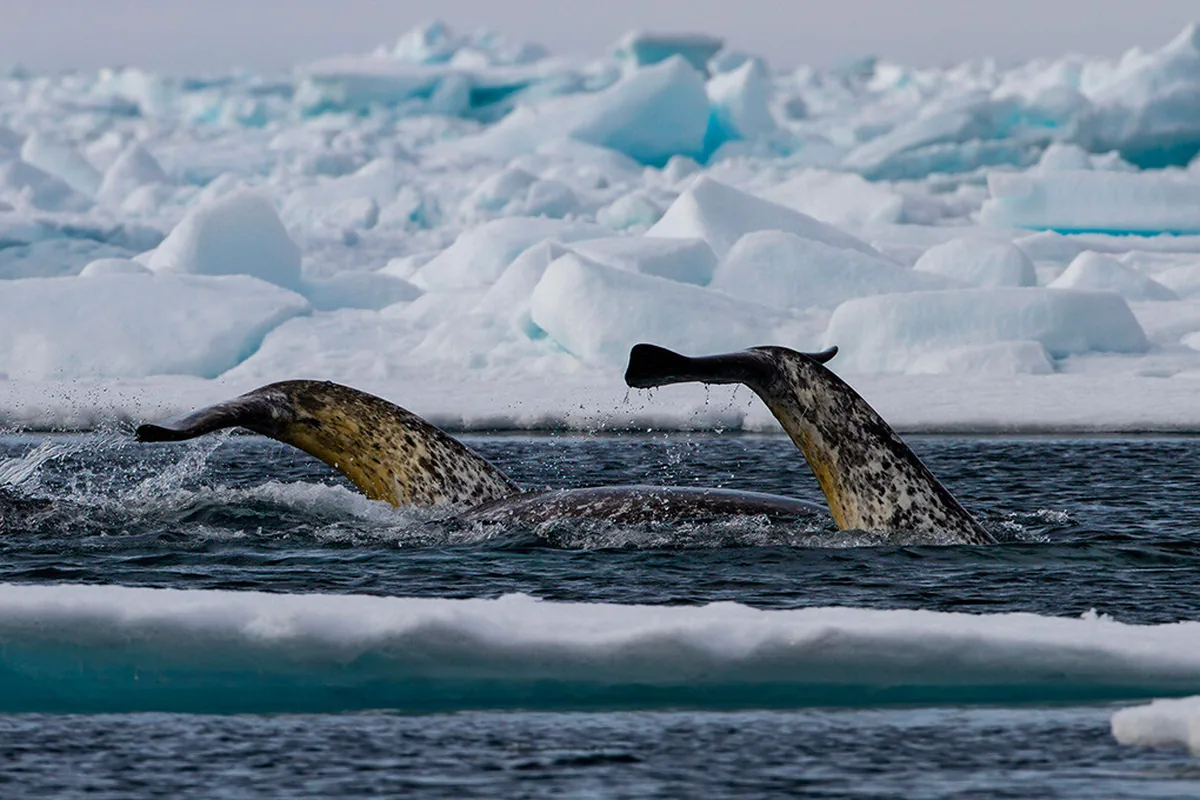
The most visually distinctive feature of narwhals is the elongated tusk present in many males. This specialized tooth can extend up to approximately 3 meters in length, effectively adding substantially to a male's overall profile. Despite this prominent appendage, the tusk represents a separate anatomical feature and is not included in standard body-length measurements.
Beyond their size, narwhals possess several physical adaptations suited to life in cold Arctic waters. They lack a dorsal fin, an important adaptation that allows them to navigate more efficiently beneath sea ice. Their bodies are notably stocky in build, and they maintain a thick layer of blubber—sometimes exceeding 15 centimeters—that provides essential insulation against near-freezing temperatures. These structural features reflect millions of years of evolutionary adaptation to one of Earth's most challenging marine environments.
Sources: NOAA Fisheries — Narwhal; IUCN Red List — Narwhal (Monodon monoceros). Educational information only. See our sources & fact-check policy.
Frequently asked questions
Male length of the how big is a narwhal??
About 4.5 m (15 ft), excluding tusk
Male weight of the how big is a narwhal??
Up to about 1,600 kg
Female length of the how big is a narwhal??
About 4 m
More in Narwhal
Explore more Arctic wildlife
Compare the narwhal with the beluga, bowhead, orca, walrus, and polar bear in our quick-facts table.
Compare Arctic species →